Pages

Showing posts with label South Korea. Show all posts

Tuesday, March 18, 2014

Korean Food: Jeon (전)


Flapjacks. Hot cakes.  Silver dollars. I love pancakes. Waffles are great. French toast is fine. But when it comes to pairing a bit of sweet with my savory at the breakfast counter, pancakes are never my second choice. While waffles and french toast can both do the same things that pancakes can, pancakes do it better. Take fruit for example, especially berries. I've seen plenty a breakfast plate sporting french toast topped with blue, rasp, and/or straw berries. I've seen waffles do the same. Pancakes, on the other hand, can arrive at the table looking plain ordinary--imperfectly circular, burnt golden on two sides, the circumference rounded with a lighter golden ring--they arrive looking like ordinary pancakes until their dressed with small amounts of butter, a swirl of maple syrup, and divided neatly in half, (six times if done correctly). The fork is gently pressed into the golden shell, it's prongs gliding down into the airy center like a pin into a pin cushion. Then, the first bite. Apple. Cinnamon. Warm apples with a hint of cinnamon. Or blueberries. Or strawberries. Or pumpkin. Lemon ricotta. Oatmeal. Carrot cake with coconut and pineapple. Everything, all of it, housed within--and perfectly distributed through--the fluffy batter; the fruit still warm and therefore countering the sweet syrup with a dull tang. It's here that pancakes achieve a level of functionality that surpasses their sweet-variety-breakfast-option comrades. The ability to appear mundane yet act extraordinary. Essentially, it's batter mixed with "stuff", poured round in oil, and lightly fried. A proven formula that manifests itself in many of the world's cuisines. The Korean version is different only in category--savory rather than sweet, paired with soju rather than coffee--the formula is very much the same.

The "batter" is flour sometimes thickened with a fermented soybean paste called doenjang. The "stuff" varies from soil to sea; potato to squid, kimchi to cod. I'm not sure it's possible to cover the Korean pancake in all of it's forms, but compiled in the list below are some of my favorites.

Haemul -- A variation of the green onion kind, or pajeon, which includes various bits of seafood among the long strands of onions. Typically, we're talking squid tentacles, miniature shrimp and clams.

Kimchi -- Exactly as it sounds. It's a kimchi pancake.

Gamja -- Potato pancakes with Asian chives, or buchu.

Gochu -- Made with finely chopped green chili peppers. To the untrained eye (mine) this one can look similar to the green onion version. You'll know it's different when your mouth lights up.

Yachae -- Another play on the green onion pancake (pajeon) only this time with zucchini.

Chamchi -- Tuna mixed with garlic and onions and seasoned with salt and pepper. It's the simplest things that go a long, long way.

Gul -- Made with oysters. I've only stumbled across this one time but it was worth remembering.

Daegu -- Despite what the name suggests this isn't made from random scraps found floating around the city of Daegu, (thankfully), it's also the name for cod. Pacific Cod to be precise.

Dubu -- Thick chunks of tofu more commonly served as a small side plate than in pancake form but delicious all the same.

Bintaetteok -- Mung beans and the kitchen sink. Various vegetables. Sometimes meat. Sometimes seafood. Always a hit.

That's just a drop in the proverbial jeon bucket. Other assortments include shiitake mushrooms and beef (pyogojeon), squash (hobakjeon), lotus root (yeongeunjeon), shredded beef (yukjeon), and edible flowers such as rose or azalea (hwajeon). The picture at the top of this post is a perfect jeon trifecta of kimchi, potato (gamja), and seafood (haemul). In no particular order, these also happen to be three of my favorites and staples among any reputable jeon jib (pancake house). The above three were prepared, cooked, and devoured on the side of a mountain, as jeon also sometimes functions as a hiking snack. Yes, in a perfect world, one I hope to see, Denver omelets will give way as blueberry pancakes will pair with the squid and onion flapjack, creating a perfect  sweet and savory pancake harmony, only fully appreciated once the Soju Bloody Mary begins to take hold.


Best of all, most of these are easy to make. I find my recipes here.

Wednesday, February 5, 2014

The Glue Sniffers

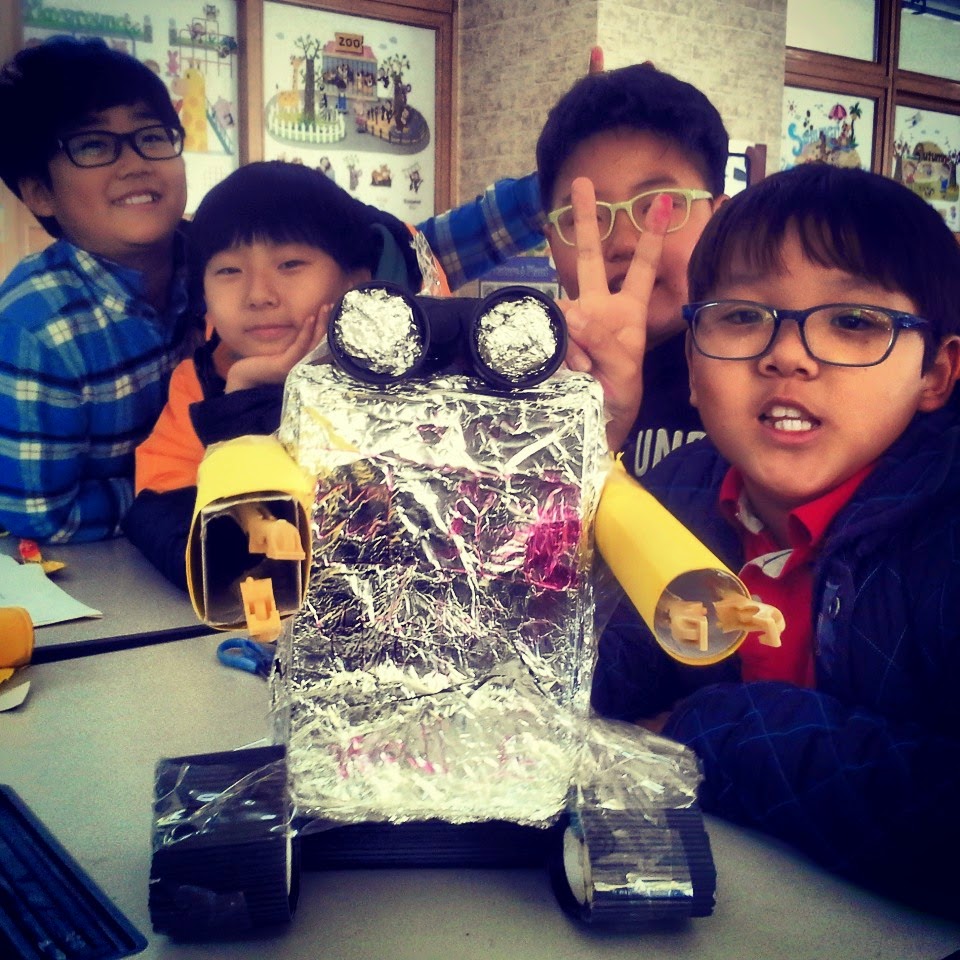
During the winter's English camp, we watched Wall-E and made robots using materials from home. It was a basic lesson about recycling, but the kids really enjoyed it. The class was split into teams and each team designed and constructed an original robot. One team, using a cereal box, toilet paper tubes, corrugated cardboard, tin foil, and binoculars, were able to replicate Wall-E almost perfectly. Pretty impressive for 4th grade students. 


The story could end here, but of course, it doesn't. This robot was unanimously voted to be the best of the class, but I didn't think it would ever leave the assembly line. These four guys spent the first 20 or 30 minutes arguing and huffing glue. Not just any glue. One of them came in with some kind of industrial strength adhesive...an entire tube of it. I first noticed when I heard some shouting and looked up to see two of them arguing over how to attach the tin foil. Pretty reasonable argument for a group of 9-year olds to be having. The strange thing was, as they argued their case, they were literally PASSING the tube of glue back and forth and sniffing it...really sniffing it, (I realize that this is pretty typical of young kids with glue, permanent markers, etc., so it wasn't necessarily the fact that they were sniffing the glue, it was more the humor of watching two kids plead their case, sniff, and pass a tube of glue to one another like some kind of piece pipe). Immediately, I intervened and suggested that they wrap the different parts with the foil and then simply tape it in place. More importantly, I used my best sign language to tell them that what they were doing with the glue was really bad for them, (point to glue--point to nose--sniffing sound--pretend to vomit--make "X" with arms). They appeared to understand and went back to work.

I'm circling the room, assisting the other groups when I hear it again. Sniffing sounds. In close succession. I turn around and sure enough, the huffing has commenced once again, only this time, while one student is feverishly marking and slicing the cardboard, his friend is holding the glue under his nose as he takes a quick sniff. The glue is then passed among the circle with each student having their go at it. I think I should back up for a second. I deliberately said "slicing" the cardboard, not "cutting" the cardboard and there's a sound reason for this. Box cutters are common classroom tools among Korean students. On the inside of every Iron Man, Angry Bird, or Elsa pencil case rests something that looks like this:


The first time that I witnessed a student pulling one of these out and unsheathing the blade, I almost tackled him. Lucky for him, I paused mid-charge as I watched him use the razor to sharpen his pencil. I then noticed that I hadn't seen a single rotary pencil sharpener anywhere in the school. He calmly, and (somewhat) safely shaved the dull tip of his pencil into a point, slid the blade back down, and secured the weapon in his pencil case. Since then, I've seen these tools used in a variety of different ways, primarily as pencil sharpeners and as a substitute for scissors, but kids are creative so they find all sorts of ways to have fun with these things.

When not being used practically, these box cutters make great tools for slicing small chunks out of rubber erasers. Said chunks are then used as projectiles against other students, usually while the teacher's back is turned, (or so they think). One time, a box cutter was used to slice long, slender strips of rubber from the side of a desk. These strips were then employed to poke other students in the back of the head from a distance of about 12 inches away. Another time, I watched as a student sharpened his pencil only to covertly dump the shavings into another student's hair. As a former mischief maker myself, I inwardly had to applaud the ingenuity, but as the resident adult I also had to send the aspiring young villain to the back of the room and make him write sentences.

Although the razors are used to forge "weapons" I have never, ever seen a student use one of the box cutters as a weapon or as a device with which to threaten, intimidate, or instill fear. The only time that I ever cringe when one of these is taken out is when a student is "changing" a dull blade. Rather than replacing the entire blade, the dull tip of the blade is muscled back and forth until it snaps off.

Back to the glue.

So I've now witnessed these kids form a glue huffing circle for the second time. I'm a fan of baseball, so my policy is usually "three strikes and you're out". This works pretty well when it comes to quieting kids down but when it comes to sniffing glue, two strikes is plenty. Without saying a word I walk over and confiscate the glue mid-rotation, replacing it with a glue stick that they couldn't really huff and thankfully, did not attempt to eat.


Tuesday, January 14, 2014

Do You Know About Kimchi?


In case you haven't heard, kimchi (sometimes spelled gimchi) is the most highly revered food in Korea. The fermented cabbage often turns up in soups, stews, as pancakes (think potato pancakes, not the breakfast kind), and on pizza, burgers, and sandwiches. I think it's great when grilled with pork, or fried with some eggs. It's eaten every day at every meal by every one. I've been told that some Koreans will even bring a stash of kimchi with them if they are travelling to another country (or even space). Basically, this stuff is more like a national treasure than a national dish.

Is it healthy?

The various health benefits of kimchi (like anything else) are widely debated but it seems like most studies agree that the stuff is loaded with vitamins and probiotics. While others fret over the levels of potentially dangerous carcinogens.

How does it taste?

Like anything else, the taste varies from place to place. Typically, I'd describe it as a spicy sauerkraut. I've had really spicy kimchi, mild kimchi, sweet kimchi with pine nuts (the best), good kimchi, great kimchi, not so good kimchi, not so bad kimchi, bad kimchi, terrible kimchi, average kimchi, kimchi fired shrimp, shrimp fried kimchi, grilled kimchi shrimp, sauteed shrimp and kimchi, shrimp burger with kimchi, kimchi burger with shrimp, lobster stuffed with shrimp and kimchi, kimchi stuffed with shrimp and lobster...

How's it made?

Excellent question! The ingredients are few: cabbage, garlic, radish, carrots, dried red pepper, dried anchovies, anchovy sauce, a jar of tiny shrimp (see below)...

Cabbage

Daikon Radish

Dried Anchovies, Anchovy Sauce, Jar O' Shrimp

Now that we have everything we need, it's time to start the process. First, the cabbage needs to be soaked in brine for about 12 hours. Just dissolve some salt, (We learned with a Korean who has been doing this since she was a little girl. Nothing was measured with utensils.), into some water and pour it over the cabbage...which should be in a large bowl...now cover the bowl of salty cabbage and let it soak overnight.

Assuming that 12 hours have passed, drain and rinse the cabbage. Now the fun begins. Take your dried anchovies and boil them in water to make a stock. I forgot to mention that you'll also need some rice powder. The rice powder is boiled until it becomes a paste. I'm really not sure about measurements here...Ours had the consistency of Elmer's Glue when it was finished:


The above mixture and some of the stock...we used about 1/4 of it...will be mixed with the red pepper flakes, some anchovy sauce (basically use this to salt the mixture to taste), and 1/2 of the shrimp jar. To give you an idea of how much red pepper we used, here are some photos of the mixture:


Chop about 10 cloves of garlic and the 2 carrots and add them to the mixture. The final result will look something like this:


Now it's time to cover the cabbage. Cut each head of cabbage in half and use the red pepper mixture as a coating. Don't be afraid the rub the mixture into all of the nooks and crannies and don't forget to wear gloves, this stuff will stain your hands (and if you're anything like me, you'll somehow end up getting the mixture inside of the gloves and up your sleeves).


Slice the radish into thick circles and cover them with the red pepper paste as well. When you finish dousing your cabbage, fold it up into a little ball and place it in the special kimchi container.


After you finish with the radish and cabbages, pour some of the remaining sauce into the container. Slap a lid on that mess and stick it in your fridge for a month. 


There you go. You should have enough kimchi to supplement long overland travel, office gatherings, baseball games, walks in the park, movie nights, game nights, deep sea exploration, intergalactic space travel...

Tuesday, November 12, 2013

A Nice Night for a Hike


For the first time since 1991 Hangeul Day was recognized as an official public holiday in South Korea. "What's the deal with Hangeul?" you ask, using your best (probably terrible) Jerry Seinfeld impersonation? Well, Hangeul is just a fancy word (actual Korean word) for the Korean alphabet which was so graciously invented by King Sejong the Great of Choseon and officially indoctrinated some 567 years ago. On October 9th, (January 15th if you live in North Korea in which case you aren't reading this blog anyway), schools, offices, (some) businesses, and (no) hospitals were closed for the day so that the people could celebrate all 40 characters properly. In spite of only being barely literate with the Korean language, we (more on that later) decided to spend our entire day off in the comfort of our beds, sleeping until the early evening. Why? Because in the wee hours of the morning we were in Busan, racing to the top of Jangsan, a mountain that faces to the east...and the sea that occupies that area...east...of Korea...

Who and/or what were we racing against and why was this particular race being held under the guise of darkness? The simple answer is: we were racing against the sun. Jangsan is famous for affording beautiful views of the sunrise as it breaches the horizon east of the sea...the sea that lies east...of Korea...

This was never intended to be a race though. Especially not against an adversary as formidable and consistent (thankfully) as that giant blinding light in the sky. The question then is this: where did we go wrong? And how many times did we go there? The answers lie in the text that follows, which I've titled:

The Search for Hangeul: A Hangeul Day Celebration

Part One: I Would Celebrate Hangeul Day by Reading the Trail Markers if There Were Only Some Trail Markers Marking this Trail That I'm On OR: (How We Added 400 Meters in 40 Minutes)

Like all memorable quests, ours (myself, Caroline and our pals Jeff and Alyssa who devoted followers of this blog might remember from such posts as this one) began in a train station at around 10:30 in the evening. Having boarded the final train for Busan Station, spirits were high as we anticipated an easy 2 hour hike to the top of Jangsan. Jeff and I had filled our packs with tools and provisions: a portable, gas powered grill, one small pot for boiling water, one french press, one small plastic bag of coffee. The girls were carrying oatmeal and fruit. Each of use had our own 2 liter bottle of water and someone was carrying an extra bottle for boiling with. I, of course, had forgotten my flashlight.

Research was done. The train would arrive in Busan about 90 minutes after departing Daegu. We'd have about an hour to kill near the station and we decided that it would best be spent fueling ourselves with coffee. The plan was to find a 24 hour coffee shop, (which is sometimes easier than finding a coffee shop that opens before 10 AM if you can make sense of that), where we would waste about an hour getting good and caffeinated before cabbing it to the park. Ideally, we'd begin the hike around 2:30 AM. The sun was due to rise around 5:30 so we'd be able to have breakfast at the top while we waited. 

The train arrives in Busan as scheduled but it's here that our seemingly flawless plan begins to go awry. All of the cafes, even the one with a big "24 hrs" window display, are closed. We settle for four cups of coffee-flavored-water at the local Lotteria, a fast food chain likened to McDonalds but more accurately comparable to some fast food knock off you're likely to find in an Indiana rest stop along Interstate 80. After "finishing" our "coffee" we head for the cab stand in front of the train station.

The streets are empty so the cab ride is quick and simple, and we're dropped off about ten minutes away from the park's entrance. Having wasted no time up to this point, the four of us make our way to the large circular area (full of exercise equipment and old men and women exercising on said equipment...after midnight...on a Wednesday...) where the main trailheads are located. It's here that our night takes a turn in the wrong direction...literally...

At the center of this outdoor fitness center, there is a large map. According to the map, the right most path leads to the peak, which is labeled "Peak" and estimated to be about 2200 meters away. We head to the right and begin slowly ascending towards the top...or so we think. Twenty minutes later we come across the first trail marker since the giant map. It reads "PEAK 2600 meters". Somehow, the same place that was 2200 meters away from the start of the trail, was now 400 meters further. Confused, thoroughly, we continued on...

After about forty minutes, all trail markers have disappeared...or at least all of the trail markers that read "PEAK xxxx m". Eventually we come to a fork with the sign pointing right telling us that it leads to a village...which is appearing on a sign for the first time...and a trail leading left which again leads to a place that was previously unlisted. At this exact moment, a pack of young Koreans on ATVs come charging up the trail behind us. Perfect! we think. We know enough Korean to ask them directions to the top of the mountain. Unfortunately, these young guys are so dumbfounded that the four of us are hiking to the top of a mountain at this hour, that they spend quite some time laughing at us and asking us why we're doing what we're doing. Finally, one of them jogs a few feet up the leftward trail and tells us that we're almost at the top.  The top, he says, is at the end of the trail going left.

We thank them and they leave but something seems strange. At the beginning of the trail, the peak was 2200 meters away. The trail heading left marks the final destination in that direction as being 500 meters away. There is no way we'd hiked 1700 meters in an hour, especially since we were climbing so gradually that we could still see some the other peaks above us. A decision needed to be made.

Here's what we knew:

The hike, according to multiple resources, should take 2 hours at the most.
The trail should have been heavily signed.
The trail wasn't supposed to be especially steep, but it should begin to climb almost immediately.
There were multiple peaks to hike to, some being deeper in the mountain.
There was a military base somewhere on the mountain.
There were areas sectioned off because of landmines.

After a quick deliberation, we decided it best to hustle back to the area with the large map...or...if you're scoring at home...the bottom of the mountain.

Part Two: In Honor of Hangeul Day I am Now Reading Dozens of Trail Markers that All Seemingly Lead to Nowhere But In the Same Direction OR: (How Many Trails Can Go Left and Still Terminate in 500 Meters?)

Back at the beginning, we searched the map for a trail leading left that might give us a decent view to the east of the mountain. We settled for Anbu, which was (supposedly) only 1900 meters away and was marked as a peak. It also appeared to be on the eastern face of the mountain. Could this have been the destination that we were looking for to begin with? It only took about 30 minutes to get back to the bottom, so we still had roughly 2 hours before the sun was due to rise. With a bit of luck, we would be able to make it to Anbu with enough time to spare for coffee and oatmeal.

Unlike our first attempt, this trail was rapidly climbing and was heavily marked with signage. The only problem being, signs literally pointed in every direction imaginable and at every junction, destinations had either disappeared completely or were being called by different names. Of course, Anbu was one such destination. Frustrated, we continued on, choosing our course based on which "trail" appeared to be changing elevation the quickest.

Having powered through for more than an hour, we reached another clearing full of signs for trails, (and also more exercise equipment), one of which indicated that Anbu was 300 meters away. A short time later, we had reached Anbu...a small clearing among some tall pine trees...with trail markers...about six of them...one of which read "PEAK 900m". It was the first sign to indicate the mountain's peak since we'd embarked on our second attempt. 

We emerged from the trees following a trail that lead through a clearing and up towards a radio tower. We reached the peak with an hour to spare and the only remaining challenge being the wind, which blew in strong from over the ocean and made lighting the gas stove extremely difficult (and probably dangerous). Luckily, we were able to keep the flame burning long enough to boil water for coffee.


And there it is--an extremely mediocre sunrise thanks in large part to the clouds that moved in right before dawn. I think there's an old cliche about the journey being the best part of blah blah blah, and that certainly holds true in this case. There's nothing quite like getting lost in the woods at three in the morning in a foreign country only to finally find your way just in time to brave the elements with aluminum foil blankets...on top of a mountain...

Whatever. Happy Hangeul Day.


Friday, October 11, 2013

I Saw a Mask Dance in Andong...


...is the title of the tenth lesson of my 6th Grade English textbook and also the title of the first lesson that I ever taught in Korea. In order to commemorate (not really) my first year of teaching English we decided to hop on a bus and head 90 minutes north to the lovely city of Andong. Andong is known for being the self-proclaimed "Korean Cultural Capital" and for having been visited by Queen Elizabeth II after she requested to see the most Korean part of Korea, but I was mostly interested in the slightly freaky masks and this:

Photo credit

Jjimdalk (찜닭), is one of my favorite Korean dishes and there just so happens to be an entire alley dedicated to serving it in Andong, (where it also is said to have originated). I'm no expert food critic and rather than pretending to be, I'm going to keep this next bit straight to the point: 

Andong Jjimdalk (안동찜닭):
A Simple Critique From a Simple Man

Andong Jjimdalk is good. It has noodles. It has onions. It has potatoes and carrots. I think I remember pieces of cabbage. The gravy is possibly derived from a soy sauce base. It's steamed in a giant cauldron. It's a little spicy. It's delicious. You should probably order a side of rice too. It pairs well with all drinks. We had water this time but sometimes we order cider and sometimes we even order beer. I'll challenge anyone to find a more perfect dish and therefore I'm giving this jjimdalk, along with all other jjimdalk variations a perfect 9/9 score, (I've already explained my theory about 1-9 being the perfect ranking system in an earlier post but I'll gladly explain it again. I'm opposed to the idea of "10" being a perfect score. I like 9 because that allows for a one number (5) to represent the absolute middle while the other numbers more accurately reflect the upper and lower echelons...in my opinion anyway...).

After another successful food review, I'll move on to the real reason for our visit to Andong: the International Mask Dance Festival.

There are several small stages within the festival grounds with performances taking place throughout the day, and one main mask dancing arena where a longer performance goes on at specified times. We caught a matinee version of "Enyul Maskdance (은율탈줌)," which has also been designated as "Important Intangible Cultural Property No. 61."

The performance consisted of 6 Acts, though sometimes it was difficult for me to determine when one act ended and another begun. Anyway, I'll do my best to chronicle the show in it's entirety.

Act 1: Lion Dance
A man and his lion take the stage. The face of the man is actually more unsettling than that of the lion who has proceeded to jump around in circles. The lion also has six legs instead of four so now I'm not quite sure if this is even a lion anymore. Perhaps it's a large, white, fuzzy insect...After reading my program, I learn that it is indeed a lion with six legs and he and his keeper are chasing the evil spirits from the stage.


Act 2: Sangjwa Dance
Sangjwa is a young Buddhist monk who comes to salute in all directions, this according to my program.


Act 3: Palmokjung Dance
A group of fun loving monks take the stage and begin dancing wildly. None of them appear to have hands...or maybe they all have wings...I'm not sure, but they sure do love to jump.


After consulting the program I've learned that the 8 monks have been corrupted by Buddhism and that is why they dance so wildly...still no information about their really long shirtsleeves...

Act 4: Yangban Dance
Straight from my program this time--A monkey appears to imply that aristocrats are worse than monkeys. I don't remember seeing a monkey or anything that resembled a monkey so I'll begrudgingly move on to the next act.

Act 5: Noseung Dance
A monk, who is probably drunk...or poisoned...or just ill...crawls to the center of the stage. After dancing for a brief time, he sits and begins to chant. My program confirms the monk's inebriation, apparently he's been drinking chrysanthemum liquor and now he is indeed chanting Buddhist scripture.


Act 6: Yeonggam Dance
This was the longest act of them all and it was also the easiest one to understand. Apparently this young woman...


...is in love with this man...


...who is married to the old lady standing on his right.


After some dancing, the younger woman confronts the older woman and eventually kills her with repeated blows to the shoulders...


At first the husband is pretty angry but he seems to get over it quickly. I won't ruin the ending...mainly because I stopped taking pictures for some reason...but a shaman comes to sort everything out. After some really cool dances, the shaman helps the spirit of the dead woman and all living parties appear to go on living happily ever after.

Getting to Andong from Daegu is simple. Just head over to Bukbu Intercity Bus Terminal, (북부정류장) or Dongdaegu Express Bus Terminal, (동대구 고속버스터미널). Buses leave every 40-60 minutes and only cost around 8,000 won. Once you arrive in Andong, stay at the bus terminal and hop on the number 46 bus towards Hanhoe Village, (하회마을). That's where most of the goings-on are going on.

Wednesday, October 2, 2013

Tongyeong or: How I Spent My Second Chuseok in Korea


On the 15th day of the 8th lunar month, Koreans take three days to celebrate the Autumn harvest. Chuseok, as it's properly called, is a time when family members return to their hometowns in order to pay tribute to their ancestors. From what I gathered last year, children return to their parents' houses, meaning there's no debate about who is hosting the feast every year. My coteacher told me that almost all Korean families will spend some time at the home of their grandparents on their mother's side, as well as some time with their grandparents from their father's side. If there are no surviving grandparents the responsibility lies with the eldest sibling. Last year, we were lucky enough, (and forever grateful), to have been invited to spend our first Chuseok with our friend Yuri and her family. If you're wondering how that went, I went through the hassle of copying and pasting the link right here: Chuseok in Gwangju

Chuseok landed on a Thursday this year, meaning we'd have the day before, (Wednesday), and the day after, (Friday), off as well so if you're keeping score at home and are capable of the most basic form of basic math, that means we'd have a five day weekend.

Last spring, a friend of ours spent a few days visiting a small port town called Tongyeong. She raved about it and we've been investigating it ever since. The five day weekend provided us an excellent excuse to purchase a bus ticket, (about 12,000-13,000 won), and endure the 90 minute ride, (buses leave from Seobu Intercity Bus Terminal, 서부정류장, every 40-60 minutes), to the southern coast.

I've recently been studying some Korean history and I've taken a liking to the (very) late, great Admiral Yi Sun Shin, (이순신). Heralded as one of the greatest naval strategists to ever sail, Admiral Yi is best remembered for his stunning defeats of the Japanese Navy during the Imjin War of the late-1500s.

Of his four campaigns during 1592, the third, and most important battle was fought in the waters south of Tongyeong, near Hansan Island. Previously, naval battles were fought in straight lines or in circular, rolling attacks. At Hansando, Admiral Yi first employed his new Crane Wing Formation, where he stacked his heavy battleships in the center with his lighter ships flanking their sides, essentially in a "U" shaped formation. Two Turtle ships, or Geobukseon (거북선), anchored the flanks on each side.

The Turtle ship's were light and fast allowing them to attack enemy ships up close and out of the range of heavy artillery. It was common for the Japanese navy to approach enemy ships in order to board them and attack with foot soldiers. Yi's ships were topped with iron spikes, so trying to jump aboard from a taller ship almost certainly meant impalement. 


Each Turtle ship was equipped with eleven cannons on each side, including two in the stern and the bow, meaning that these ships could attack head on or while in retreat. There were numerous hatches and small holes along the sides from which arrows, guns and mortars were fired. The dragon figurehead at the front of each ship held up to four additional cannons and was used to confuse the enemy by emitting smokescreens.


Yi was wildly victorious at Hansando, destroying 66 of the 133 Japanese ships while retaining all 56 of his own and losing only 19 men in battle. While the victory at Hansando is most impressive it pales in comparison to the Battle of Myeongnyang. In October, 1597, Admiral Yi lured 333 Japanese ships into the Straight of Myeongnyang near Jindo Island on Korea's southwestern coast. By the battle's end, 31 Japanese ships were completely destroyed, 92 others had been rendered disabled, and approximately 8,000 Japanese soldiers had been lost. Two of Yi's men were killed. Three were wounded. And all 13 of his ships remained intact. You read that last part right. Thirteen of Yi's ships were responsible for the defeat of 333 Japanese vessels.

If this guy had played for the Cubs he'd almost certainly have a statue in front of Wrigley Field.


Coincidentally, I was just attacked by 6 third graders wielding plastic samurai swords. After a brief struggle, one Derek Teacher was able to successfully repel the little hooligans. I'll be erecting my own statue in the English classroom later this week.

Now that I've bored everyone with historical facts, here are some other highlights from the trip.

Dongpirang was a poor neighborhood and slated for redevelopment when a bunch of resident artists protested by painting murals all along the alleyways. The artwork saved the hillside community and is now one of the most visited attractions in the city though I have to imagine property value has since increased dramatically.


There are numerous islands to explore south of the mainland and the ferry terminal located near the harbor services many of said islands several times a day. Bijindo came highly recommended by a few of our friends and coworkers. During the off season, only three ferries sail for Bijindo daily: one at 7:05, one at 11:00, and one at 2:00. We wanted to make the most of our time so we were off with the sunrise.


There are technically two roads on the entire island but really this road just forks and then circles through the village.


We took a quick but grueling hike, (as none of us were prepared to climb straight up for 3 km.)...


...and then we spent some time in the sun...


...before calling it a day...or a morning rather.


By mid-day, fatigue had started to set it, (evidenced below), so we ferried back to the mainland for some afternoon naps.


And finally, a special thanks to our pals Jeff and Alyssa for being great company throughout the weekend.