Pages

Showing posts with label Daegu. Show all posts

Wednesday, February 5, 2014

The Glue Sniffers

During the winter's English camp, we watched Wall-E and made robots using materials from home. It was a basic lesson about recycling, but the kids really enjoyed it. The class was split into teams and each team designed and constructed an original robot. One team, using a cereal box, toilet paper tubes, corrugated cardboard, tin foil, and binoculars, were able to replicate Wall-E almost perfectly. Pretty impressive for 4th grade students. 
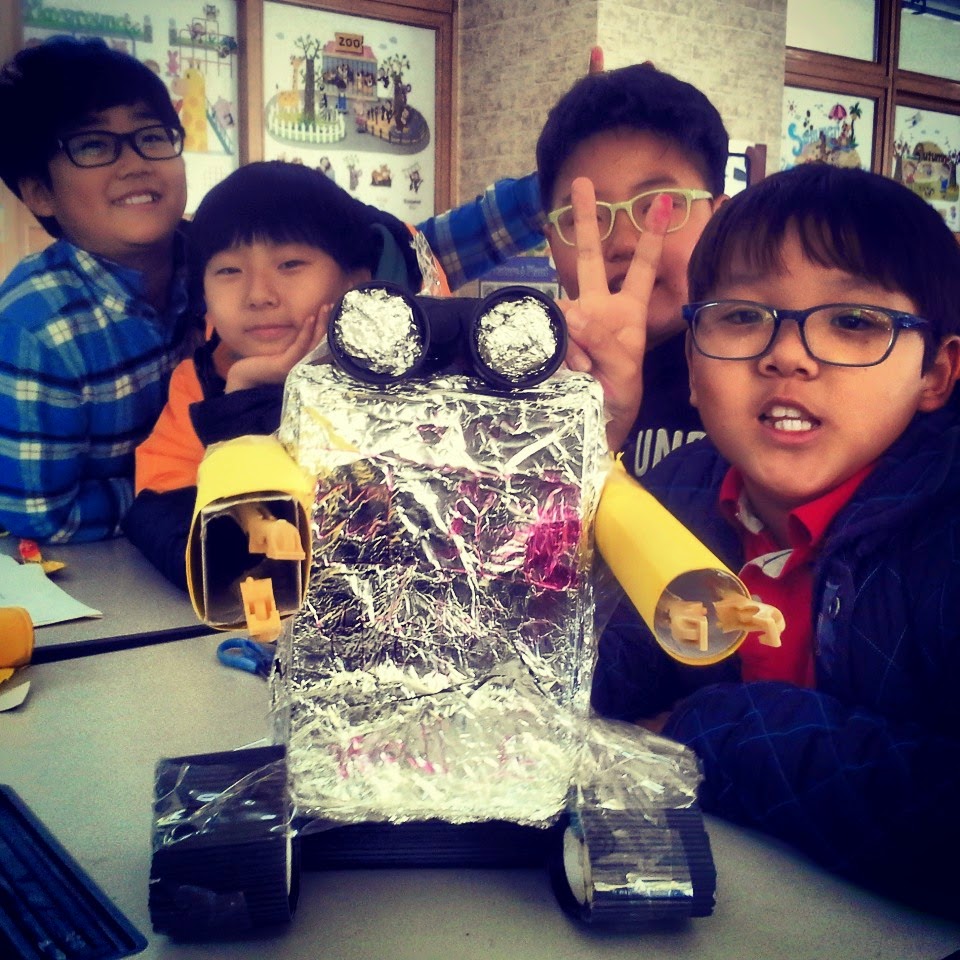

The story could end here, but of course, it doesn't. This robot was unanimously voted to be the best of the class, but I didn't think it would ever leave the assembly line. These four guys spent the first 20 or 30 minutes arguing and huffing glue. Not just any glue. One of them came in with some kind of industrial strength adhesive...an entire tube of it. I first noticed when I heard some shouting and looked up to see two of them arguing over how to attach the tin foil. Pretty reasonable argument for a group of 9-year olds to be having. The strange thing was, as they argued their case, they were literally PASSING the tube of glue back and forth and sniffing it...really sniffing it, (I realize that this is pretty typical of young kids with glue, permanent markers, etc., so it wasn't necessarily the fact that they were sniffing the glue, it was more the humor of watching two kids plead their case, sniff, and pass a tube of glue to one another like some kind of piece pipe). Immediately, I intervened and suggested that they wrap the different parts with the foil and then simply tape it in place. More importantly, I used my best sign language to tell them that what they were doing with the glue was really bad for them, (point to glue--point to nose--sniffing sound--pretend to vomit--make "X" with arms). They appeared to understand and went back to work.

I'm circling the room, assisting the other groups when I hear it again. Sniffing sounds. In close succession. I turn around and sure enough, the huffing has commenced once again, only this time, while one student is feverishly marking and slicing the cardboard, his friend is holding the glue under his nose as he takes a quick sniff. The glue is then passed among the circle with each student having their go at it. I think I should back up for a second. I deliberately said "slicing" the cardboard, not "cutting" the cardboard and there's a sound reason for this. Box cutters are common classroom tools among Korean students. On the inside of every Iron Man, Angry Bird, or Elsa pencil case rests something that looks like this:


The first time that I witnessed a student pulling one of these out and unsheathing the blade, I almost tackled him. Lucky for him, I paused mid-charge as I watched him use the razor to sharpen his pencil. I then noticed that I hadn't seen a single rotary pencil sharpener anywhere in the school. He calmly, and (somewhat) safely shaved the dull tip of his pencil into a point, slid the blade back down, and secured the weapon in his pencil case. Since then, I've seen these tools used in a variety of different ways, primarily as pencil sharpeners and as a substitute for scissors, but kids are creative so they find all sorts of ways to have fun with these things.

When not being used practically, these box cutters make great tools for slicing small chunks out of rubber erasers. Said chunks are then used as projectiles against other students, usually while the teacher's back is turned, (or so they think). One time, a box cutter was used to slice long, slender strips of rubber from the side of a desk. These strips were then employed to poke other students in the back of the head from a distance of about 12 inches away. Another time, I watched as a student sharpened his pencil only to covertly dump the shavings into another student's hair. As a former mischief maker myself, I inwardly had to applaud the ingenuity, but as the resident adult I also had to send the aspiring young villain to the back of the room and make him write sentences.

Although the razors are used to forge "weapons" I have never, ever seen a student use one of the box cutters as a weapon or as a device with which to threaten, intimidate, or instill fear. The only time that I ever cringe when one of these is taken out is when a student is "changing" a dull blade. Rather than replacing the entire blade, the dull tip of the blade is muscled back and forth until it snaps off.

Back to the glue.

So I've now witnessed these kids form a glue huffing circle for the second time. I'm a fan of baseball, so my policy is usually "three strikes and you're out". This works pretty well when it comes to quieting kids down but when it comes to sniffing glue, two strikes is plenty. Without saying a word I walk over and confiscate the glue mid-rotation, replacing it with a glue stick that they couldn't really huff and thankfully, did not attempt to eat.


Tuesday, January 14, 2014

Do You Know About Kimchi?


In case you haven't heard, kimchi (sometimes spelled gimchi) is the most highly revered food in Korea. The fermented cabbage often turns up in soups, stews, as pancakes (think potato pancakes, not the breakfast kind), and on pizza, burgers, and sandwiches. I think it's great when grilled with pork, or fried with some eggs. It's eaten every day at every meal by every one. I've been told that some Koreans will even bring a stash of kimchi with them if they are travelling to another country (or even space). Basically, this stuff is more like a national treasure than a national dish.

Is it healthy?

The various health benefits of kimchi (like anything else) are widely debated but it seems like most studies agree that the stuff is loaded with vitamins and probiotics. While others fret over the levels of potentially dangerous carcinogens.

How does it taste?

Like anything else, the taste varies from place to place. Typically, I'd describe it as a spicy sauerkraut. I've had really spicy kimchi, mild kimchi, sweet kimchi with pine nuts (the best), good kimchi, great kimchi, not so good kimchi, not so bad kimchi, bad kimchi, terrible kimchi, average kimchi, kimchi fired shrimp, shrimp fried kimchi, grilled kimchi shrimp, sauteed shrimp and kimchi, shrimp burger with kimchi, kimchi burger with shrimp, lobster stuffed with shrimp and kimchi, kimchi stuffed with shrimp and lobster...

How's it made?

Excellent question! The ingredients are few: cabbage, garlic, radish, carrots, dried red pepper, dried anchovies, anchovy sauce, a jar of tiny shrimp (see below)...

Cabbage

Daikon Radish

Dried Anchovies, Anchovy Sauce, Jar O' Shrimp

Now that we have everything we need, it's time to start the process. First, the cabbage needs to be soaked in brine for about 12 hours. Just dissolve some salt, (We learned with a Korean who has been doing this since she was a little girl. Nothing was measured with utensils.), into some water and pour it over the cabbage...which should be in a large bowl...now cover the bowl of salty cabbage and let it soak overnight.

Assuming that 12 hours have passed, drain and rinse the cabbage. Now the fun begins. Take your dried anchovies and boil them in water to make a stock. I forgot to mention that you'll also need some rice powder. The rice powder is boiled until it becomes a paste. I'm really not sure about measurements here...Ours had the consistency of Elmer's Glue when it was finished:


The above mixture and some of the stock...we used about 1/4 of it...will be mixed with the red pepper flakes, some anchovy sauce (basically use this to salt the mixture to taste), and 1/2 of the shrimp jar. To give you an idea of how much red pepper we used, here are some photos of the mixture:


Chop about 10 cloves of garlic and the 2 carrots and add them to the mixture. The final result will look something like this:


Now it's time to cover the cabbage. Cut each head of cabbage in half and use the red pepper mixture as a coating. Don't be afraid the rub the mixture into all of the nooks and crannies and don't forget to wear gloves, this stuff will stain your hands (and if you're anything like me, you'll somehow end up getting the mixture inside of the gloves and up your sleeves).


Slice the radish into thick circles and cover them with the red pepper paste as well. When you finish dousing your cabbage, fold it up into a little ball and place it in the special kimchi container.


After you finish with the radish and cabbages, pour some of the remaining sauce into the container. Slap a lid on that mess and stick it in your fridge for a month. 


There you go. You should have enough kimchi to supplement long overland travel, office gatherings, baseball games, walks in the park, movie nights, game nights, deep sea exploration, intergalactic space travel...

Thursday, June 6, 2013

Gatbawi


Once a single granite stone, this carving dates all the way back to the 9th century.  During the 7th year of Queen Seondeok of the Silla Kingdom's rule, a young man by the name of Uihyeon ascended 2,790 feet to the top a round hill and carved the statue in order to appease his ailing mother's soul.  Legend persists that the statue will answer only the prayers of those who pray with their entire heart.  Every fall, thousands of Koreans from all over the country make the trek in order to pray for their children's success on the college entry exams.  

The name "Gatbawi" comes from the flat rock situated on the top of the statue's head.  The rock resembles a traditional Korean hat, or a "Gat", and the word "bawi" means rock or stone in Korean.  The hike only took about an hour and half and it wasn't too strenuous as the rocky terrain provided a bit of a staircase that wound up through the pine.

A temple usually signals the beginning of a hiking trail and this one began at Gwanam Temple.  The temple complex was of average size and positioned so that benevolent mountain spirits could flow southward down the mountain to greet mankind.   


Although foot traffic on the way up was pretty light, the mountain top was teeming with people wishing good fortune upon the statue. 


And finally, Old Stone Hat himself.


Wild Korea

I think I've said this before, but wildlife in Korea is pretty scarce.  Aside from a few Wild Josh sightings, I haven't really come across anything else worth noting.

Until now:


The Wild Korean Rock Tailed Mountain Cat Lion


The extremely rare Mountain Pigeon


This sign translates to read "Beware of the storks overhead, as they will drop unclaimed children on you."


...no it doesn't.


Thursday, May 30, 2013

Market Tours -- Seonam Market


It's come to my attention that after 9 months of living here and countless (25) blog entries, only a handful (1 or 2) have anything to do with the city that I'm calling home.  So if you've ever found yourself wondering how I've been spending my free time in Daegu, then I suggest you consider finding a hobby.  If a hobby is too much work, then you're in luck because I've begun to tour some of Daegu's traditional street markets.

I get a kick out of strolling through the markets.  There's nothing quite like them back home.  I suppose flea markets would pose a fair comparison, but most of the flea markets that I've enjoyed are seasonal and usually limited to one or two days a week, (and you'd be hard pressed to find a flea market where people are literally butchering livestock in front of you while simultaneously hocking items like socks, hiking apparel, and kitchen utensils).  The markets here are open everyday of the year.  There is no sign that reads "weather permitting".  The scents and the scenes change every 40 steps or so and the food is plentiful and cheap.

At first glance, especially to an untrained eye such as your own, these markets all appear to be larger or smaller versions of the same thing, and to that I say...yeah, for the most part, the market places are all fairly similar.  They can all be (and will be) rated on criteria such as: Food, (duh), Variety, (obscure vendors score points here), and Freaky Deaky (the main reason why I go to these places).

I'll be using an arbitrary rating scale of 1-9. I'm sick of ten being the gold standard.  And an odd number makes one number, 5 in this case, the middle, therefore actually allowing the system to account for "average".  

The first market I'll sample is Seonam Market which is located just west of Duryu Park, (not to be confused with the much larger and much more well known Seomun Market).


Sidewalk/street vendors like these are a telltale sign that a traditional market is close by.  A dead giveaway would be the cart of flower printed pants in the foreground.


The main stretch.  Surprisingly mellow for a nice Saturday afternoon.


The streets leading into the market were lined with giant heaps of garlic.  You could probably smell this place from 3 miles away.


Here's a cart full of dried fish; some of it bagged, some of it boxed, and some of it just lying there with glassy eyes and mouths agape.


They were grinding these chilies into powder which noticeably altered the air quality in this corner of the market. 


Not much to say about this.  Just a bunch of fish.


Pajeon!  (파전)  Somewhere between a Korean pancake and a Korean pizza depending on which type you order.  The kimchi variety, (far left, front row), is my favorite.


Rice Cakes (떡).  These little guys come in all shapes and sizes and make for the perfect Market-strolling-snack.  Not pictured are the ones rolled in sesame seeds with red bean paste in the middle.  My coteacher brings them to school sometimes and if it wasn't rude to do so, I'd devour them all.


Just some fish on a grill.


Jokbal (족발).  Boiled pig's feet.  That's what you're looking at.  Pig's feet that have been boiled for hours in a giant vat in some darkened alley.  Sounds pretty dodgy but it's quite tasty especially when it's paired with kimchi and wrapped in a sesame leaf.  Seonam Market is famous for this stuff and had I known beforehand, I would have sampled the goods.  I find it hard to believe that one section of town can boil feet better than the other, but I'm not a podiatrist.  I am however an expert when it comes to this:


Mandu (만두)  Step aside other street foods.  Mandu is my absolute favorite snack in Korea.  I call it a snack because it's not really a meal even though me and someone who shall remain nameless (Josh) may or may not have (may have) devoured upwards of 25-30 of these guys in one sitting.  (Don't look at me like that).  That's 25-30 between two of us.  An easy feat considering 10 of the smaller ones, which are filled with either minced pork or kimchi and minced pork (the best kind), are usually around 3500W (2.50 USD).     


I shall refer to these as Garage Sale Stores.  Every market has at least one.  Some have two or three, (or more).  While it looks like some post apocalyptic-roadside-gypsy camp, these are usually fairly organized establishments, (organized in a way that if you ask the owner for something, they usually have it and they usually know exactly where it is).


This picture is relevant because all over the city we've seen watermelon priced exuberantly.  I'm talking upwards of 22,000W (about 21 USD).  I've named this place the Mom and Pop Melon Platform/Store.  You can see the actual storefront in the background of the photo.  The whole place was full of melons and some of these melons, (the smaller lot), were going for a very affordable price of 4,000W (3 USD).  Caroline loves watermelon so she was happy to buy one though I keep forgetting to ask her how it was.


I mentioned her excitement but did you think her head would actually turn into a watermelon?


Seonam Market
Size: Average

And now for the best part.  As mentioned, I'm going to arbitrarily rate Seonam Market on a scale of 1-9 in the following 3 criteria: Food, Variety, and Freaky Deaky.  I've chosen to use spatulas to represent the ratings.  Why?  I don't know, it was the first word that popped into my head.  

Food: I've definitely seen a larger variety of foods at other markets but all of the food here at Seonam looked and smelled really good.  
Score: 6 spatulas

Variety: Nothing jumps out at me here. 
Score: 3 spatulas

Freak Deaky: Multiple pig foot boiling stations.  One or two butchers dismantling entire hogs.  Not much else though.
Score: 3 spatulas 

Total Score: 12/27

Not a bad score considering this market flies under the radar.  Although the Freaky score was lower than what I'd like to see in a market, I'd definitely head back to this place as the prices were more than fair and the people running shop were very friendly.  


Wednesday, January 16, 2013

EPIK Life: Desk Warming and Winter Camp

Before I get into Winter Camp, let me begin by detailing the Korean school year.

School begins on March 1st and the first semester ends in July.  There is a summer vacation from sometime in July until sometime in August.  (I know that "sometime" is pretty vague, but this is almost a direct quote from my Co-Teacher so I'm sticking with it).  The second semester begins in late August, maybe the final week, and runs strong until the end* of December.  There are two months of winter break; January and February.  

*It's worth pointing out that while students take their finals during the first week of December, we still teach until the end of the month.  It's a little strange to teach from the textbooks after the kids have completed their finals, but that's just the way it goes.

Two months break in the summer and two in the winter.  Seems like a pretty sweet deal, right?  And it is a sweet deal if you happen to be a student or a non-contract teacher, and you guessed it, I am not a student and I am a contract* teacher.  

* There are plenty of Korean teachers who are also contract teachers, and they are also required to desk warm during vacations. 

This means that I'll be showing up for school everyday during the winter break.  This is called "desk warming" and if you find yourself sitting in an expat bar around late-December or late-June, you'll find that the air is ripe with conversations about how much "this just sucks, man.  What am I going to do for 2 months?"  

Don't fret my fellow and/or prospective Guest English Teachers, most of us will have 1 or 2 weeks of camp to keep us occupied.  Then the students will come back to school for a week (?) in February...in order to....do...things...

It's also worth pointing out that we are allotted 10 days of paid vacation in the winter.  Couple those days with a few weekends and it bumps up to 16.  Not such a bad deal at all.

Camp is basically just an excuse to have some fun while teaching the students.  Kids sign up and come and go as they please, (or at least they did at my camp and my co-teachers didn't seem to mind).  My camp began after the New Year and lasted for 5 days.  Here are some of the highlights:

Superheroes:  When I was young, I loved superheroes.  Luckily, movies like Iron Man, Spider Man, and Batman are very popular here in Korea, so the kids also share my sentiments.  They got to create their own heroes, give them powers, and then design their costumes.  After that, we played a game where each team had to guess which hero I like more.  For some reason they just absolutely love trying to guess things about me.  In one class, the boys and the girls were divided into two teams.  The boys had 15 points and the girls had 1, so I decided to make the final question worth 14 points.  The girls finally guessed the correct answer and I almost had a riot on my hands.

Monsters:  They love horror movies here so I introduced them to some classic American horror films like Frankenstein, The Creature from the Black Lagoon, and Wolfman.  Then the kids played a game in which they rolled some dice and created a monster of their own.  Each side of the die corresponded with different monster parts.  They simply drew the part based on the numbers they were rolling.  It was good fun.  After that, we made our own monster masks.  Most of the kids wanted to make zombie masks so I used this as an opportunity to gross out my co-teachers by leaving still images from zombie movies up on the screen while the kids tried to replicate the gruesome faces.  Here's a few of my favorites:


Canape(?):  According to one of my co-teachers, Canape is some kind of French pastry(?) or treat(?).  I wasn't sure, so I looked up a definition using a highly reliable source, (not Wikipedia) and I came to learn that canape is indeed a French word meaning "couch".  Upon further investigation, I can confirm that canape is basically a small, decorative, handheld food that is eaten in one bite, also know as an appetizer.  Anyway, I  had no idea what to prepare for this but luckily my co-teachers already had a plan and a "recipe".  First, I'll just list the ingredients.  Pay close attention and try to visualize a "small, usually decorative, handheld food".

1 piece of toasted white bread cut into 4 squares
1 Ritz cracker
1 smear of cream cheese
1 piece of yellow American cheese, unwrapped and divided into 4 squares
1 slice of tangerine
1 cherry tomato, halved
a few raisins

Does this sound all fancy and French-like to you?  Well, allow me to continue.

First, smear the cream cheese on the toasted bread.
Second, place the Ritz cracker on top of the cream cheese.
Third, place the American cheese on top of the cracker,
Fourth, place the tomato and tangerine slices on top of the cheese.
Fifth, garnish with raisins.

So basically we just made a weird, open-faced, cheese sandwich that looked like this:


In case you are wondering, I didn't try one.  Something about it just didn't really pique my interest.  The kids seemed to enjoy it though and after about 5 minutes, it turned into "who can stuff the largest pile into their mouth", documented here:


Pizza Party: No camp would be complete without one.  I don't really need to explain this so I won't.

Pizza Famine